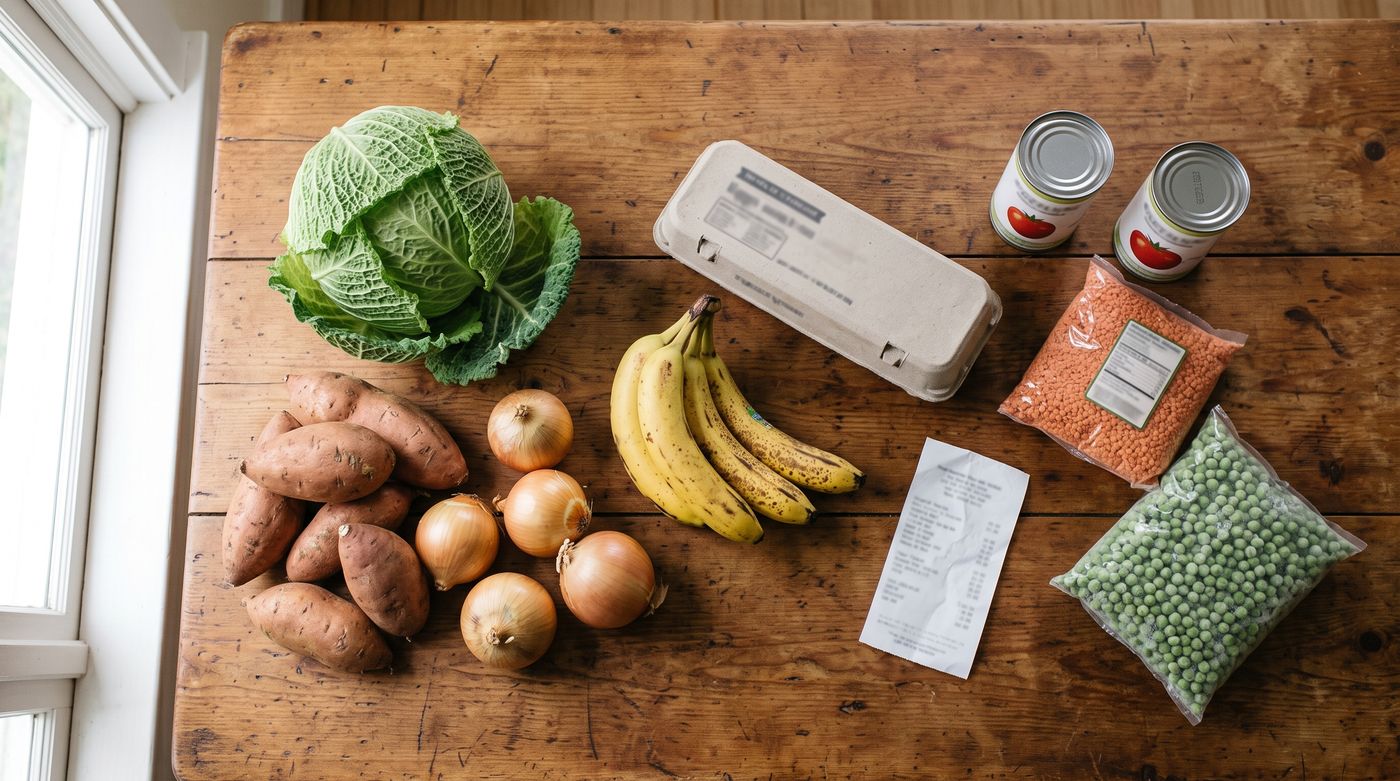
Every June 1st, Florida performs its opening-day ritual: the TV weatherperson gestures at a cone, the big-box stores build a plywood-and-bottled-water pyramid by the entrance, and somebody tries to sell you a $150 bucket labeled “Emergency Food Supply, 30 Days.” I have opened one of those buckets. It is full of powdered things that taste like drywall and regret. And here’s the late-October truth nobody puts on a pyramid: the season runs through November 30th, and the Tampa Bay area has a long history of storms that show up after everyone’s stopped paying attention. So this is my version — a hurricane pantry built entirely out of cheap, shelf-stable food I cook with all year anyway. It costs about as much as one restaurant dinner, and if the storm never comes, it simply gets eaten. Nothing is wasted except the weatherperson’s dramatic pause.
The $39 pantry, itemized
House rule: if I claim a number, you get a table. Real St. Pete prices, mostly Aldi with a couple of Publix sale grabs. This feeds two adults for a solid week-plus without a single powdered drywall brick:
| What | Why it earns the shelf | What I paid |
|---|---|---|
| Long-grain rice, 5 lb | The backbone — cooks over any flame | $3.49 |
| Dried red beans, 2 lb | Monday magic, storm or no storm | $2.98 |
| Red lentils, 1 lb | Cook in 25 minutes, no soak, no fuss | $1.95 |
| Pasta, 2 boxes | Ten-minute dinner on a camp stove | $2.18 |
| Oil-packed tuna, 4 cans | Protein that needs zero refrigeration | $4.36 |
| White & black beans, 4 cans | Dinner even if you can’t boil water | $3.56 |
| Canned tomatoes, 3 | Turns rice and beans into actual food | $2.67 |
| Coconut milk, 2 cans | Shelf-stable richness, no cooler required | $2.90 |
| Peanut butter, 40 oz | The morale department | $3.95 |
| Saltines + the good crackers | Delivery system for the above | $2.50 |
| Shelf-stable milk, 2 quarts | Coffee survives the storm too | $3.58 |
| Instant coffee | Non-negotiable. Ask anyone who’s met me. | $3.29 |
| Water — refill your own jugs at the grocery machine | 39¢ a gallon beats $1.50 a bottle | $1.56 |
$38.97. Compare that to the pallet-of-bottled-water-and-granola-bars panic run, which routinely clears $100 and feeds nobody dinner.
The whole trick: buy food you already eat
The reason the $150 bucket is a bad deal isn’t just the price — it’s that it only has one job. It sits in a closet depreciating until either a storm comes or it expires, whichever is sadder. Every line in my table has two jobs. The dried beans and rice are Monday red beans and rice at $1.41 a serving, which I’m making anyway. The tuna and white beans are the 20-minute pantry pasta that has rescued more of my weeknights than I care to admit. The lentils and coconut milk are the cheapest soup on my site, $1.06 a bowl. This is the rotation principle: the hurricane pantry is just the deep end of the regular pantry. Eat from it all year, replace what you use, and keep the waterline at about two weeks of food through November. Nothing ever expires, because nothing ever sits.
Plan the no-power menu, not just the shopping list
When the power goes out, you eat in order: fridge first (that’s day one — consider it a mandate to finish the good leftovers), freezer second, pantry last. The pantry list above assumes you can boil water on something — a gas stove, a grill with a side burner, or a little camp stove, which thrift stores in Florida sell constantly because camping here is a thing people try once. If you’re buying the stove secondhand, give it the same once-over as anything else with moving parts; my sixty-second testing routine applies to storm gear exactly as it does to waffle irons. And build one honest no-cook tier: the canned beans, tuna, peanut butter, and crackers will carry you through a day when boiling water feels like a major life project. There is no shame in a peanut-butter-saltine dinner by flashlight. There is, frankly, a little romance in it.
The late-season clearance play
Here’s the move the June crowd never sees. Come late November, the big-box stores quietly clear out the whole hurricane endcap — coolers, lanterns, batteries, tarps, water jugs — because the seasonal aisle needs the space for inflatable snowmen. That’s when you buy next June’s gear for pocket change, the same way November 1st is the real Halloween shopping day. The thrift stores run the same sale year-round: I count coolers on every single visit, usually $4–$6 for the big ones, and a tarnished-but-perfect Coleman lantern is practically a St. Pete thrift-store mascot. Prep season for thrifty people isn’t June. It’s December, at 75% off.
Thrifty upgrade: before any storm, freeze every empty jug of water you can fit in the freezer. Frozen jugs keep the fridge cold for a day after the power drops, then melt into drinking water — two jobs again. And leave a quarter on top of a frozen cup of water in the freezer before you evacuate: if you come home and the quarter has sunk, everything thawed and refroze, and the freezer food goes. A 25¢ food-safety instrument.